
The Science of Whole Wheat Baking
That little wheat berry is a seed, a food supply, and a protective coat—all in one. Grind the whole thing into flour, and every part comes along for the bake.
Why does stone-ground whole wheat feel different from white flour? Let’s open up a kernel, then zoom into the dough to see what happens when you add water, knead, and let it rise.
The dissection
Three parts. Three different jobs.
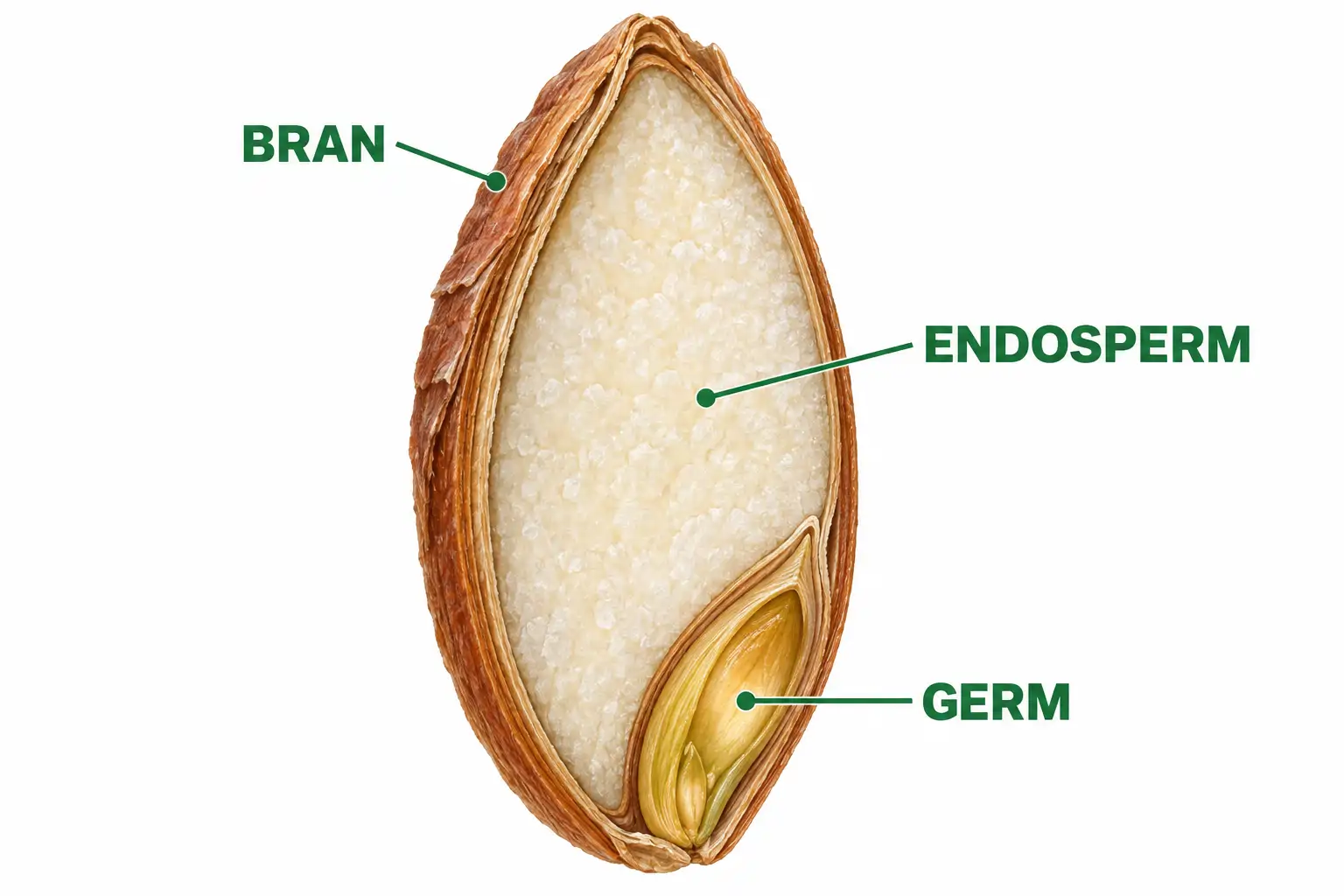
A simplified wheat-kernel cutaway. Colors distinguish the parts; layers are exaggerated for clarity. This is an illustration, not a microscope image.
Bran: the outer layers
The fiber-rich covering of the edible kernel. Bran is several layers, not a single shell. Milling breaks it into the brown flecks you see in whole-wheat flour.
Endosperm: the pantry
The largest part holds stored starch and proteins to support the young plant. It supplies most of the material in refined white flour, including the proteins that form gluten.
Germ: the new plant
The small embryo can grow into a wheat plant. It contains oils, vitamins, and minerals. “Germ” here means the beginning of a plant, not a disease-causing microbe.
Whole-wheat flour keeps bran, germ, and endosperm in their original proportions. Refining removes most of the bran and germ. Bran belongs to the edible kernel; it is different from the husks and chaff removed during grain processing.
“Stone-ground” and “whole wheat” tell you different things.
Stone-ground describes the milling method. Whole wheat describes what stays in the flour. A stone-ground flour can be sifted, so check the label. Store-bought whole-wheat flour also contains bran and germ; these baking differences are not unique to a farm mill.
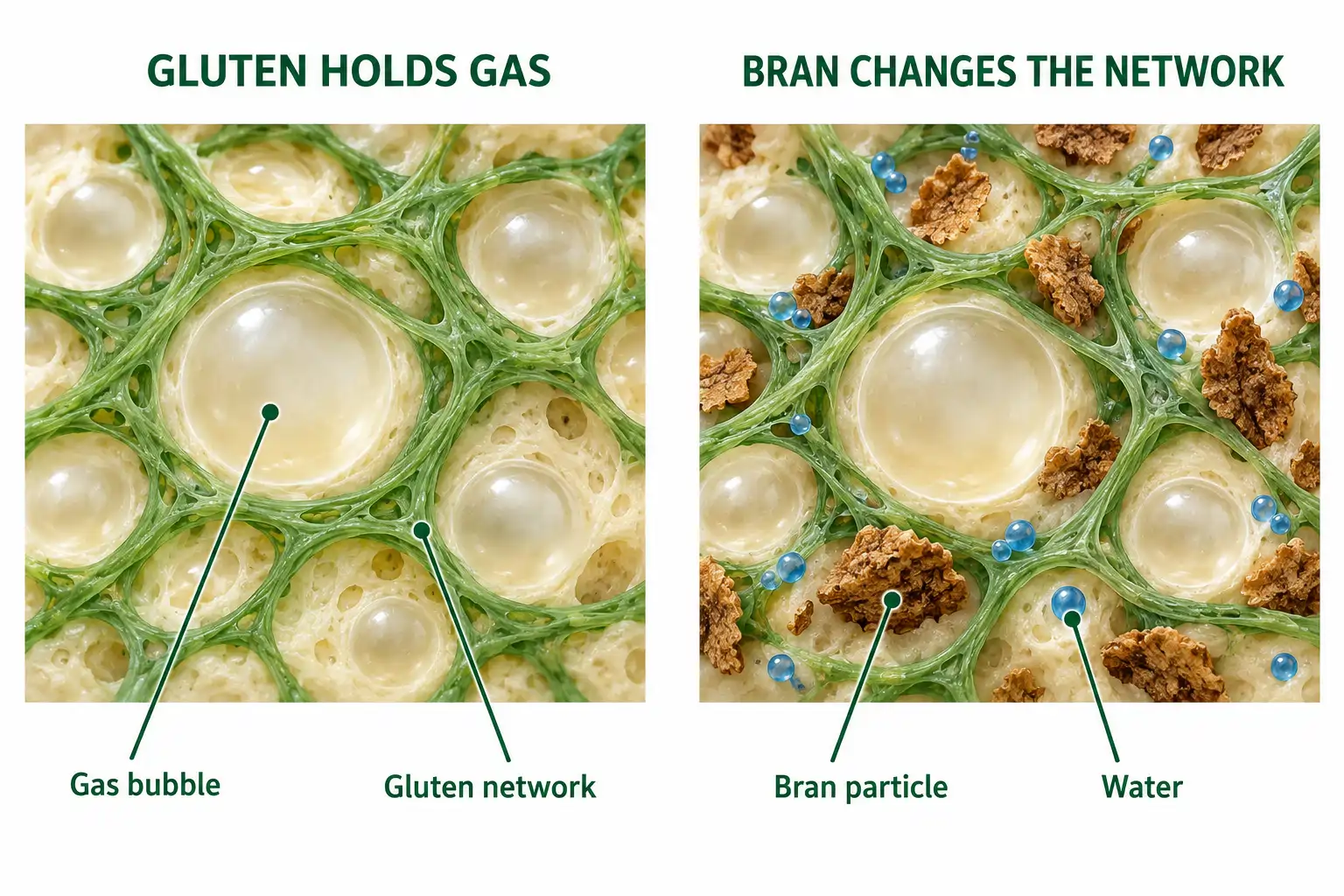
A conceptual close-up, not a literal view of dough. Green strands represent gluten, brown pieces represent bran, and blue dots represent water. Real dough also contains starch and other components omitted here for clarity.
Bran gets in the way
Irregular bran particles can physically interrupt the gluten network. Their edges may contribute to disruption, but the familiar explanation that “sharp bran cuts gluten” is incomplete. The effects depend on particle properties, water, and the dough around them.
Bran also takes up space without contributing the same gluten-forming material as endosperm. A network that is less continuous may retain gas less effectively.
Bran changes where water goes
Bran’s fiber binds water, changing how much is available to hydrate proteins and starch. Chemical interactions also matter. This is why adding whole wheat to a white-flour recipe can change dough behavior even when you measure everything the same way.
Particle size is part of the story, too. Smaller is not automatically better in every formula: changing the grind changes surface area and hydration behavior.
Bran is part of the ingredient—not a defect.
The answer is to help the dough work with the whole kernel. Enough water, time to hydrate, and appropriate dough development can improve the loaf while keeping its bran and germ.
Bring the science to the counter
What this means for your next loaf
| What’s happening | What you can do |
|---|---|
| Flour needs time to hydrate | Mix flour and water, cover, and rest 20–30 minutes before kneading. Judge the dough after the rest. |
| Whole wheat changes water demand | Begin with a whole-wheat recipe. Add water gradually if the rested dough is stiff; avoid burying sticky dough in extra flour. |
| Gas needs a supportive network | Knead or fold as your recipe directs. Look for improving elasticity and cohesion, not a perfectly clear windowpane through bran. |
| Expansion has a limit | Watch the loaf’s rise and strength. Extra proofing cannot fix weak dough and can let a promising loaf collapse. |
A five-minute setup: feel hydration happen
You’ll need two small bowls, whole HRWW flour, water, and a scale.
- In the first bowl, mix 30 g flour with 24 g room-temperature water. Cover and wait 30 minutes.
- Make the same mixture in the second bowl immediately before comparing them.
- Press and gently stretch each mixture. Notice changes in stiffness, stickiness, and cohesion.
This compares freshly mixed flour with flour given time to hydrate. Your results depend on the grind and flour; it does not isolate bran alone or predict final loaf height. These mixtures contain no yeast, so this is a feel test, not a bread recipe. Do not taste raw flour or dough.